



May 23–25, 1996
Invitational Composers’ Competition
After the highly successful first competition for solo singers, the devoted cultural workers from the town on the Tisa organized the 4th “Horizons on the Tisa”, held from May 23 to 25, 1996, as the first invitational composers’ competition for solo song.
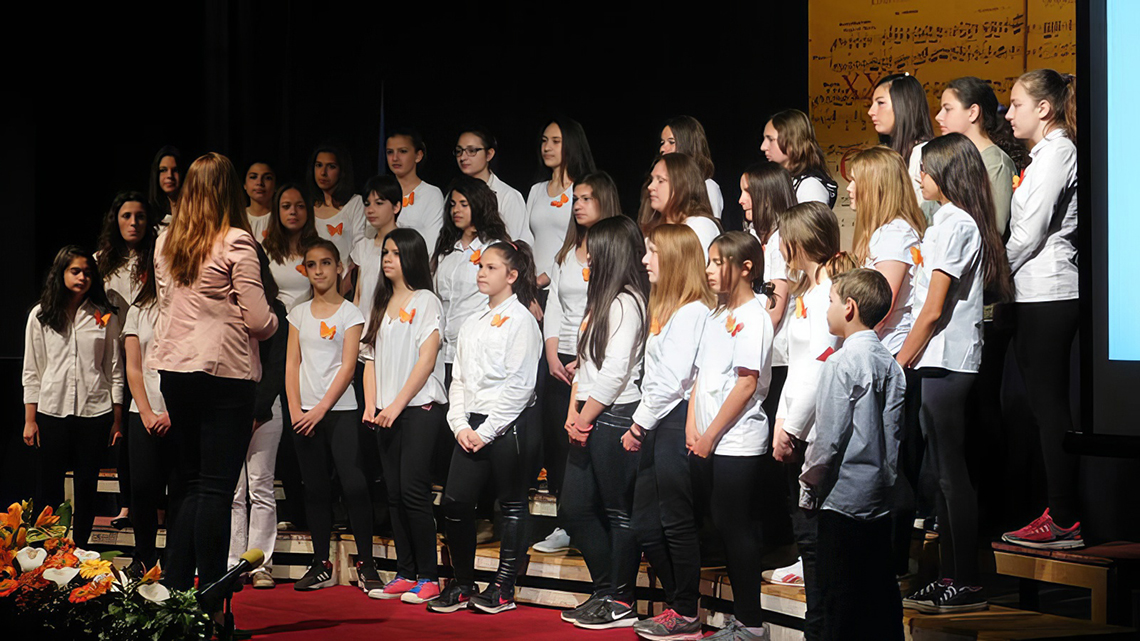
Concert of the Radio Television Belgrade Choir
Acknowledging the significant role of Josif Marinković in the field of choral music and his long-standing work as a choir conductor, the organizers paid special tribute to the Radio Television Belgrade Choir, conducted by Bojan Suđić, inviting them to open the festival.
The program prepared by this leading Serbian vocal ensemble was presented in two parts. The first featured Marinković’s compositions To the Heavenly King and excerpts from his Liturgy.
The second part was dedicated to Stevan Mokranjac and his Rukovet suites (Nos. II, V, VIII, X, and XI), with remarkable solo performances by baritone Dragoljub Đorđević, tenor Karolj Kolar, and soprano Ivana Radivojević.
Before the concert, ethnomusicologist Dr. Dragoslav Dević gave a commemorative address dedicated to Josif Marinković, highlighting the importance of his creative work in both sacred and secular music, and emphasizing that Marinković was the first Serbian composer to introduce piano-accompanied choral works.
In his eloquent speech, Dević stated:
“I would like to emphasize another form closely associated with the name and work of Josif Marinković in Serbian art music – the solo song with piano accompaniment.
Excluding arrangements of folk melodies, we can distinguish two types of his solo songs: those inspired by the spirit of folk creativity (Šano dušo, Stojanke) and those based on literary poetry.
Marinković’s romantic lyricism is revealed in his deep understanding of the text’s psychological character, his careful attention to diction, and his refined piano accompaniment. For these reasons, he is rightly regarded in Serbian musical historiography as the founder of the Serbian art song.”
Composers’ Competition for Solo Song
Aiming to encourage creativity and inspire composers to write new works, the organizers sent invitations to 20 Serbian composers, asking them to submit original solo songs with piano accompaniment on the theme “Bread, Grain, Harvest”, previously unperformed works.
Fourteen composers responded, and their pieces were premiered on the second day of the festival, performed in the following order:
(The numbered list of composers, titles, and performers follows — unchanged in content.)
First Prize to Konstantin Babić
The jury — composed of Rajko Maksimović (President), Biserka Cvejić, Ivan Jevtić, Miroslav Štatkić, and Zagorka Jegdić — decided to award four prizes.
The first prize (2,000 dinars) went to Konstantin Babić for Saturdays of My Childhood, performed by Jelena Vlahović.
The second prize (1,500 dinars) was awarded to Dejan Despić for Two Songs, performed by Željko Lučić.
Two third prizes (700 dinars each) were given to Vojin Komadina for Bojana, the Maiden, interpreted by Aleksandra Ivanović, and Zoran Hristić for Festive Bread, performed by Vladimir Andrić.
The winner of the first invitational composers’ competition, Konstantin Babić, also received a painting by Slobodan Jeremić Jeremija as an additional award for the best solo song on the festival’s theme.
The Audience Award went to Dimitrije O. Golemović for Autumn Farewell, performed by Željko Lučić with pianist Ljubica Grujić.
Awards:
- Konstantin Babić (1927) – Saturdays of My Childhood
- Dejan Despić (1930) – Two Songs
- Vojin Komadina (1938) – Bojana, the Maiden
Zoran Hristić (1933) – Festive Bread
Audience Award:
Dimitrije O. Golemović (1954) – Autumn Farewell
“Horizons” in Negotin
That the invitational composers’ competition for solo song achieved its purpose — to revive and encourage creation within this somewhat forgotten musical form — was confirmed at the 31st Mokranjac Days in Negotin.
At the Negotin Cultural Center, on September 28, 1996, a Vocal Concert of New Serbian Solo Songs was held, featuring eight compositions from the first “Horizons on the Tisa” competition.
Performers included:
Vladimir Andrić (Nikola Petin – Prayer, Zoran Hristić – Festive Bread),
Jelena Vlahović (Vera Milanković – Secret Places, Konstantin Babić – Saturdays of My Childhood),
Željko Lučić (Dušan Radić – Bread, Dimitrije O. Golemović – Autumn Farewell), and
Violeta Srećković (Svetozar Saša Kovačević – Lullaby, Vojin Komadina – Bojana, the Maiden).
Piano accompaniment: Ljubica Grujić.
The program also featured actor Mirko Petković.
Exhibition on Teodora Boberić-Arsenović
As part of the accompanying program, an exhibition titled “Teodora Boberić-Arsenović” was held at the “Selo” Gallery in cooperation with the Museum of Theatrical Arts of Serbia, curated by Mirjana Odavić.
Visitors could see posters, photographs, diplomas, programs, and costumes belonging to the opera diva and film actress — a pioneer of Serbian opera and a leading actress of the National Theatre Drama in Belgrade.
Teodora Boberić-Arsenović was born on December 22, 1885, in Vranjevo, where she completed elementary and two years of civic school. She sang in the church choir and participated in an amateur theatre group, where her beautiful and richly colored voice was soon noticed.
During a theatre tour in Vranjevo, playwright Branislav Nušić, then dramaturge of the National Theatre in Belgrade, recognized her talent and invited her to join the ensemble. She became a temporary member in 1906 and a full-time member in 1909, remaining with the theatre until her retirement in 1951.
Over her fifty-year career, she performed 16 roles in operas and operettas, more than 200 dramatic roles, was a beloved interpreter of folk songs on Radio Belgrade, and appeared in four films.
Her film debut came in 1911, portraying Jelena, the wife of Karađorđe, in the first Serbian feature film The Life and Deeds of the Immortal Leader Karađorđe, directed by Ilija Stanojević.
Toward the end of her life, in 1959, she played Grandmother Evgenija in the film The Door Remains Open, alongside Milena Dravić, who played her granddaughter.
Teodora Arsenović passed away in Belgrade on October 18, 1960.


Comments