



May 25–27, 1995
Open Competition for Solo Singers
After the first two “Horizons on the Tisa,” the organizers began preparations for the third festival with even greater enthusiasm and foresight.
Excellent cooperation was established with the Ministry of Culture of the Republic of Serbia, which once again provided support of great importance. On the local level, the event also received strong backing, with the President of the Municipal Assembly, Dragan Belić, accepting to head the Organizing Committee.
Following the first editions of the festival, it became evident that a suitable formula was needed to ensure that the Days of Josif Marinković could survive amidst the abundance of musical events across Serbia. Several meetings were held between the organizers and members of the Artistic Council in Belgrade and Novi Bečej. It was decided that “Horizons on the Tisa” would alternate biennially between competitions for solo singers and invitational composition contests for new solo songs.
In accordance with this plan, the 3rd “Horizons on the Tisa”, held from May 25 to 27, 1995, took place as the first open competition for solo singers.
Tribute to Marinković’s Legacy
The manifestation was officially opened by academician Dr. Dejan Despić, who emphasized the richness and importance of Josif Marinković’s work in his address:
“These lovely May ‘Horizons,’ dedicated to the memory and creative work of the author of Spring Dawn, take us back—just as the Mokranjac Days in Negotin do—to the dawn of Serbian music, which began with the works of two great composers and remains illuminated by their legacy...
There is good reason why the organizers decided to place emphasis this year on the Open Competition for Solo Singers, thereby honoring Marinković’s achievements in the field of solo song while also highlighting their broader artistic significance. In our music, he was the first to elevate this vocal form to a truly artistic level, seeking to bring it closer to the concept and artistic reach of the Lied, which acquired its widely accepted German name thanks to composers such as Schubert, Schumann, and later Brahms, who established it as the most perfect fusion of poetry, voice, and piano.
Perhaps this very time of ours—when many avant-garde storms have already passed, and when greater attention is once again devoted to the heritage of our cultural ancestors—is the right moment to re-evaluate and appreciate Marinković’s work from a clearer, more balanced perspective. These ‘Horizons,’ held in the composer’s homeland, are certainly the best occasion and most fitting setting for such reflection.”
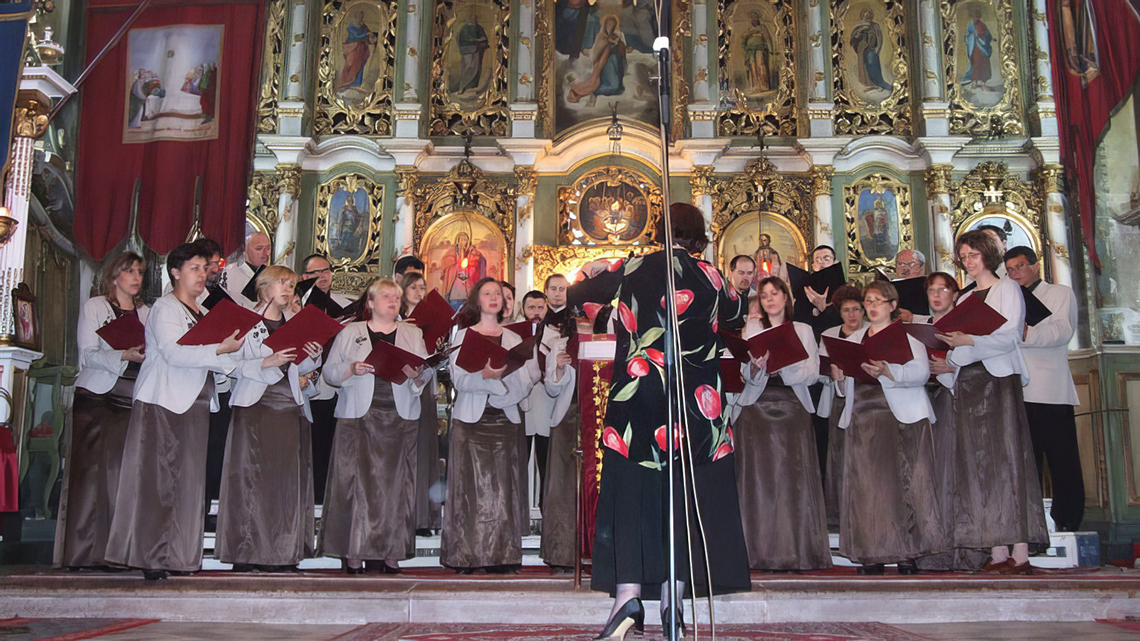
The first festival evening concluded with a concert by the “Josif Marinković” Choir from Zrenjanin, conducted by Andrej Bursać, with pianist Edita Majorfi. The ensemble performed two compositions by Marinković (On Good Friday and The Third Kolo – “Branko’s Kolo,” inspired by The Students’ Farewell by Branko Radičević) and four choral suites by Stevan Mokranjac (V, X, XI and XV).
The Solo Singing Competition
The following two days of the festival were dedicated to the first competition for solo singers. Invitations, along with the competition rules, were sent in advance to students of the Faculty of Music Arts in Belgrade, the Academy of Arts in Novi Sad, and the Music Academy in Sarajevo. Interest was high—20 candidates applied, 14 of whom actually performed. The competition was held in three stages.
The first stage took place on May 26, in the morning, at the “Selo” Gallery, without an audience. Among the 14 participants, female voices predominated: six sopranos, five mezzo-sopranos, and three baritones. Each candidate was required to perform one solo song and one aria of their choice.
(The list of competitors follows unchanged.)
After the first round, Vesna Petković and Dragana Radovanović did not advance to the next stage.
The second stage was held the same evening before an audience. Contestants were required to perform one solo song by Josif Marinković, one solo song of their choice, and an operatic aria selected by the jury.
After a two-hour concert and lengthy deliberations, the jury decided that nine singers would advance to the final stage the following evening.
The final round featured nine contestants—three male and six female singers—each performing one solo song and one operatic aria chosen by the jury.
The jury consisted of: Biserka Cvejić (President), Radmila Bakočević, Vera Kovač Vitkai, Konstantin Babić, and Dr. Dimitrije O. Golemović.
Željko Lučić – Unmatched Talent
In the male category, the first prize was awarded to Željko Lučić (27), a baritone from Zrenjanin and student of the Academy of Arts in Novi Sad under Professor Biserka Cvejić. He confidently performed Germont’s aria from La Traviata, Rodrigo’s aria from Don Carlo by Giuseppe Verdi, and Marinković’s solo song From Town to Town, winning the admiration of both the jury and the audience.
The second prize went to Vladimir Andrić, one of the youngest participants—a baritone from Valjevo and student of solo singing at the “Slavenski” Music School in Belgrade under Professor Olivera Grujić Slavić. His rendition of From Town to Town was particularly impressive, as was his performance of Papageno’s aria from Mozart’s The Magic Flute.
The third prize was awarded to Dejan Jovanović, a student of the Faculty of Music Arts in Belgrade under Professor Radmila Bakočević, for his performance of Marinković’s Oh, Moon and the Count di Luna’s aria from Verdi’s Il Trovatore.
In the female category, competition was intense from the start. Despite the high quality of all participants, the jury decided not to award a first prize.
The second prize was shared equally by mezzo-sopranos Nataša Jović (Banja Luka) and Tanja Obrenović (Užice).
The third prize was shared by soprano Dragana Radivojević (Novi Sad), mezzo-soprano Violeta Srećković (Kragujevac), and mezzo-soprano Aleksandra Angelov (Belgrade).
Soprano Aleksandra Stamenković from Belgrade did not receive an award.
The “Josif Marinković” Award was presented to Vladimir Andrić for his interpretation of Marinković’s From Town to Town.
Concert by Dubravka Nešović
The closing event was a concert by the renowned performer of old urban songs and Russian romances, Dubravka Nešović, a native of Novi Bečej. She performed alongside several guests, including actor Aljoša Vučković, delivering a remarkable evening of music and emotion.
With her great artistic talent, Dubravka Nešović set the stage for a joyous celebration on the terrace of the Workers’ Home. In a relaxed and cheerful atmosphere, the participants of the competition sang late into the night, welcoming the beautiful May dawn and the first glimmers of sunlight on the crystal-clear surface of the Tisa River – the beloved beauty of Banat.
Tapestry Exhibition
As in the previous two years, the Days of Josif Marinković included an accompanying visual arts program with two exhibitions.
In the lobby of the Workers’ Home and at the “Selo” Gallery, paintings and tapestries by Giga Đuragić Dileta from Kovilj were displayed. Particularly striking were his large-format tapestries, crafted in his own studio and at “Atelier 61” in Novi Sad. Those placed on stage served as a unique scenic backdrop.
In the small hall of the Workers’ Home, the exhibition “Bread and Ritual Cake among the Serbs – Terracotta by Tibor Nađ” was opened — a joint project of the Novi Bečej Cultural Institution and the Museum of Ritual Bread, founded by painter Slobodan Jeremić Jeremija from Pećinci.


Comments