



The Existing State of The Church Prior to The Renovation
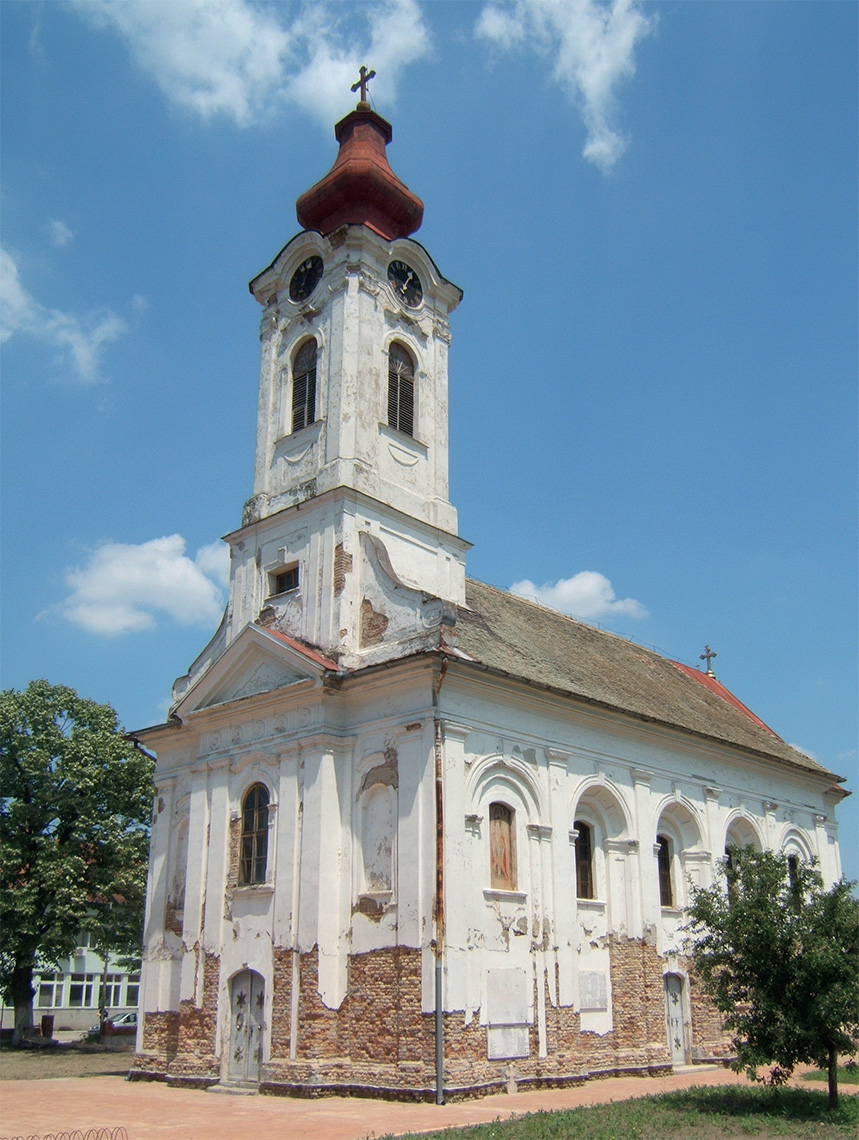
Church of St. Nicholas in Novi Bečej was in very poor condition due to many years of decay and inadequate building interventions that presented a danger to the building. A damage of the mural paintings and decoration on the ceilings, arches and walls occurred because of leakage.
The heaviest damage was visible on the walls due to the effects of rising damp.
There were no cracks inside, which would indicate the subsidence of the walls. The roof structure of the nave of the church was in good condition, with no visible damage.
The interior of the building has also been severely affected by the various forms of moisture.
On the church vault, one could notice the moisture that originated from atmospheric water that penetrated some places where the tiles or sheet metal elements were damaged. The wall has also been permeated with atmospheric water from downpipes, which caused falling of the plaster, peeling paint and cracks to occur. The rising damp went up to 4.0 m inside the church, so it was necessary to break off the walls and re-plaster them.
The moisture has eroded the wooden doors as well as the parts of the church mobiliar.
Work on The Restoration of The Church
Institute for Protection of Cultural Monuments Zrenjanin created “Conservation Architectural and Construction Project for the Restoration of the Church” in 2009, at the request of the Serbian Orthodox Church of Novi Bečej.[25]
 In September 2009, the work began on plaster on the outside and inside walls of the church at the height of rising damp.[26] The interior walls were, after removal of the tables and thrones, also broken up to the necessary height. Cutting the church walls for the purpose of
the rising damp treatment was carried out in October 2009.[27]
Since the church is old and valuable, all the works were carried out based on previous research and conservation project, under the supervision of the Institute for Protection of Cultural Monuments Zrenjanin. An ideal reconstruction of the facade was carried out according to the existing condition and original documentation.
Due to the extent of the work, which was a consequence of the poor condition, there were phases in conducting the work.
During the first phase, a research work was carried out as well as the work on the exterior of the church - roof repairs and replacement of the roof covering with new biber tiles, repairs of the roof structure of the nave and church tower, installation of new copper sheet on the cap of the tower, breaking and plastering the façade, installing new metal sheets and constructing a new sidewalk.
In the second phase, works on the construction of the new fence wall around the churchyard were carried out as well as arranging the churchyard, based on special project documentation.[28]
At the beginning of the work, replacing the existing old tiles was carried out with new biber tiles, modeled after the authentic tiles.[29] Before installing the tiles, the roofing battens on the entire roof surface had been replaced. Metal sheets were made of new zinc-coated painted steel.
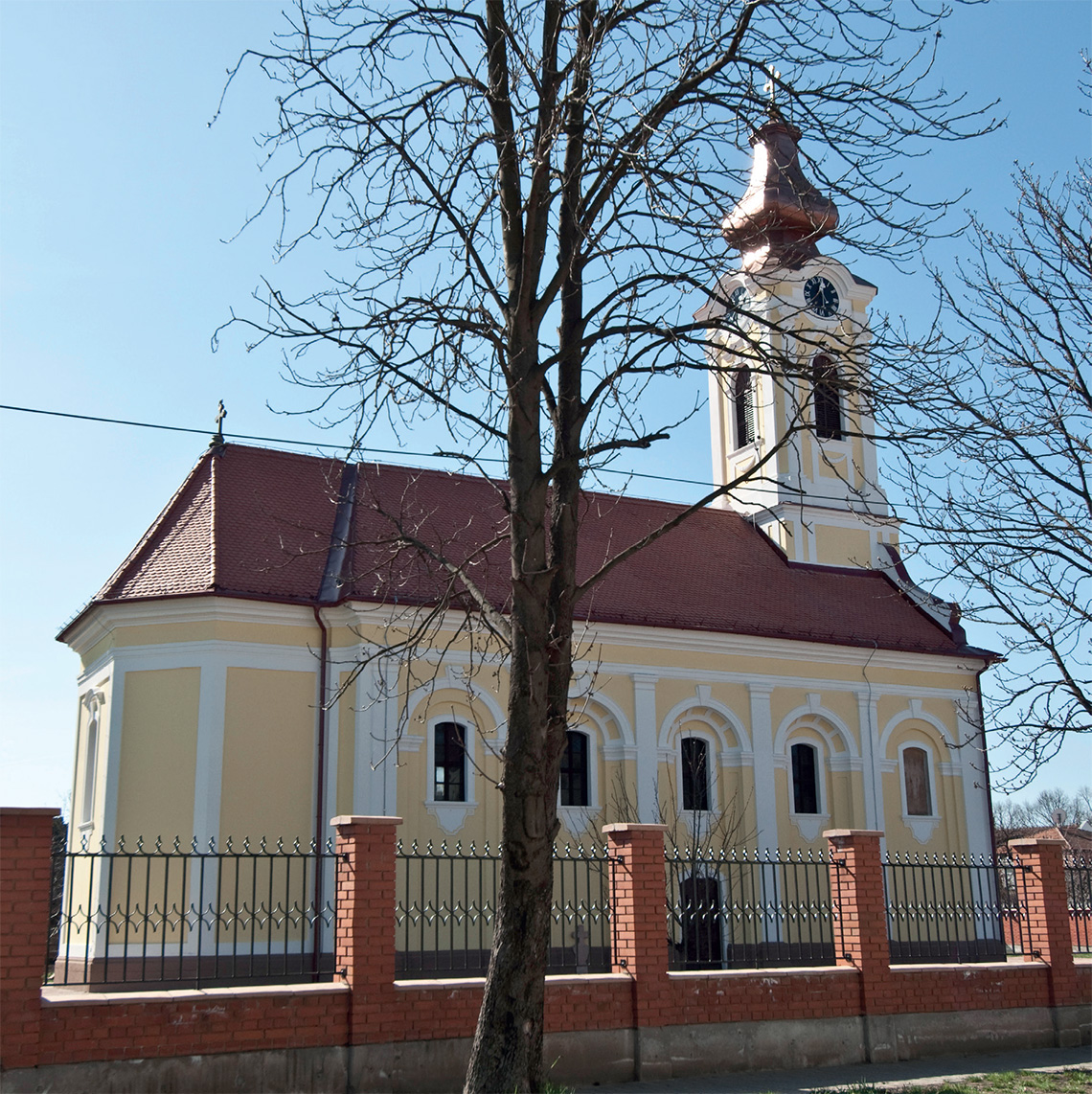 After that, dilapidated plaster was taken down from the entire surface of the facade of the nave and the bell tower, the joints were cleaned, and so all traces of the old mortar were removed. Localized cracks and fractures in the mortar were deepened and cleaned from the remnants of old mortar and then injected with lime cement mortar. After taking down the damaged mortar on the facades, prints are taken from the well-preserved parts of the mortar plastic by producing the steel templates. New decoration was made completely mirroring the authentic one.[30]
On the lower part of the facade, up to the intersection of walls, plastering with sanitation mortar was carried out. New plastering, above the section, was done with lime cement mortar – the first layer with fraction.
After mounting renewed decorative elements, the entire facade was treated with quality facade dispersion paint in two coats, in a hue that had been confirmed by the professional service of the Institute before the work began, and which applied to painting of the basic as well as emphasized elements. The skirting was painted with silicate paint.
The woodwork on the church had been also worn out. The blinds on the bell tower were in the worst condition, and so the new ones were made from quality pine, dry and aged, without knots and entirely modeled after the original ones.
A new sidewalk was constructed around the church in order to protect the building from the impact of atmospheric deposits.[31]
Upon the completion of all works on the restoration, the Church of St. Nicholas in Novi Bečej was given a completely new look, suitable to its importance and value as a cultural property.
[25] Chief designer was Spomenka Urošević, an architect conservator, with her associates Vesna Majstorović and Bojan Kojčić, historians and art conservators.
[26] The contractor was company „Fenix“ from Novi Sad.
[27] Cutting the walls was carried out by HIO method by company “Oberknežev” from Novi Sad.
[28] The project documentation was made by JSC „Projektni biro“ from Kikinda with the responsible designer Miroslav Adamović, B. Eng. in Arch.
[29] The manufacturer of roof tiles is the company „Polet“ from Novi Bečej.
[30] Plaster-decorating work was performed by Imre Ambrus and Branislav Kirćanski.
[31] The contractor for the sidewalk was the company „Graditelj“ from Kikinda.
Comments