



Besides the Women's Russian Gymnasium – Kharkov Institute, Novi Bečej had an eight-grade or, as it was then called, a complete gymnasium from 1924. Its full name was: "Private Mixed Full Real Gymnasium with Public Rights in Novi Bečej." This gymnasium had the same rights as state gymnasiums, with the difference that its maintenance was covered partly by the municipality and mostly by students' families.
The tuition fee depended on the tax level paid by the students' parents. Poor students were exempt from tuition, but there were very few such cases, as impoverished families were eager for their children to grow up and start working for employers or become apprentices to relieve the family of their support.
The Novi Bečej gymnasium was actually relocated from Žombolj when Yugoslavia ceded this town to Romania in 1923 in exchange for Jaša Tomić and Pardanj (Međa). The director of the gymnasium, Vladimir Zdelar, was a long-time professor at the Second Boys' Gymnasium in Belgrade and had previously run a private school in Belgrade. Thus, establishing a private gymnasium in Novi Bečej was neither new nor unfamiliar to him.
The school was welcomed by the people of Novi Bečej and Vranjevo, as well as those from Stari Bečej, since at that time, Stari Bečej had only a lower four-grade gymnasium. Consequently, more than thirty students from higher grades commuted daily by boat from Stari Bečej to Novi Bečej. Additionally, students came from nearby villages such as Melenci, Kumane, Beodra, and Dragutinovo (Novi Miloševo), as well as from Kikinda and Bečkerek (Zrenjanin). Across all eight grades, the school had between 260 and 280 students.
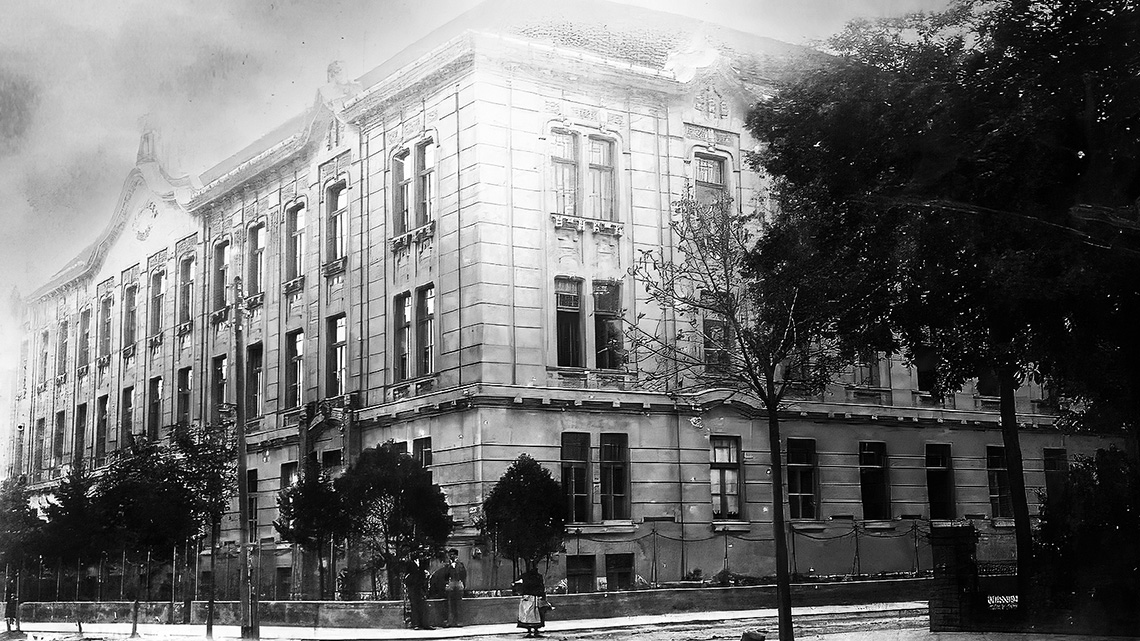
During the 1929–30 school year, the gymnasium had 163 students, but that year, it only operated higher grades (IV to VII). The school’s facilities were inadequate for proper instruction in the lower grades (I, II, and III), as had been the case in previous years. However, in the following 1930/31 school year, the first and second grades were reopened (likely due to securing sufficient space), as one class of 28 students graduated from the eighth grade. This assumption is based on reports stating: "The school operated this year in a large, three-story state building, also housing a civic school and an elementary school. The allocation of rooms was not rationally arranged, causing significant disruptions to classes. For instance, elementary and gymnasium classes were on the top floor, while civic and elementary school classrooms were on the floor below. Moreover, only five rooms were allocated for gymnasium classes, two of which were exceptionally small. A more efficient and rational solution for the school’s future development is imperative."
The gymnasium employed six permanent professors and four part-time teachers. Unlike the Civic School, where teachers had fewer teaching hours, gymnasium professors had a significantly higher workload, reflecting the private institution's efficiency in utilizing resources.
Professors of the Private Gymnasium in Novi Bečej (1929/30):
- Dragutin T. Simonović, Director, 16 years of service (3 at this school). Taught Botany (V grade), Zoology (VI grade), and Geology (VII grade). 7 weekly hours. Former Inspector of the Ministry of Education (retired).
- Ante A. Jagić, Professor, 36 years of service (4 at this school). Taught Latin (V–VIII grades) and Serbian (IV, VII, and VIII grades). Homeroom teacher of VIII grade. 28 weekly hours. Retired professor.
- Ivan L. Podgornij, Assistant Professor, 18 years of experience (6 at this school). Taught Mathematics (V–VIII grades), Chemistry (IV and VII), and Physics (VII and VIII). Homeroom teacher of VI grade. 29 weekly hours.
- Aleksandar P. Belikov, Professor, 5 years of experience (2 at this school). Taught German (V–VIII grades), Philosophy (VIII), History (V), and Geography (IV). Homeroom teacher of VII grade. 24 weekly hours.
- Olga A. Belikov, Assistant Professor, 4 years of experience (3 at this school). Taught French (all grades) and Serbian (V and VI). Homeroom teacher of V grade. 24 weekly hours.
- Radomir P. Pavić, Assistant Professor, 1 year of experience (at this school). Taught History (IV, VI, VII, VIII grades) and Geography (IV, V, VIII). Homeroom teacher of IV grade. 17 weekly hours. Joined on February 15, 1930, replacing Persida Miladinović and Janja Vidaković.
Financial Overview (1929/30):
The school was funded primarily through tuition fees. The municipality of Vranjevo contributed a significant donation of 8,000 dinars.
Total revenue:
- Collected by June 28 – 293,550 dinars
- Outstanding by June 28 – 10,350 dinars
- Total: 303,900 dinars
Total expenses:
- Paid by June 28 – 273,500 dinars
- Unpaid by June 28 – 3,016 dinars
- Total: 276,516 dinars
Thus, the 1929/30 school year ended with a budget surplus.
Unfortunately, due to poor facilities, economic crisis, and declining enrollment from nearby villages, the gymnasium ceased operations in 1931.
As a result, Novi Bečej lost both of its gymnasiums in the same year, depriving the town and its economy of an important institution and a significant number of consumers of local goods at a crucial time.

Comments