



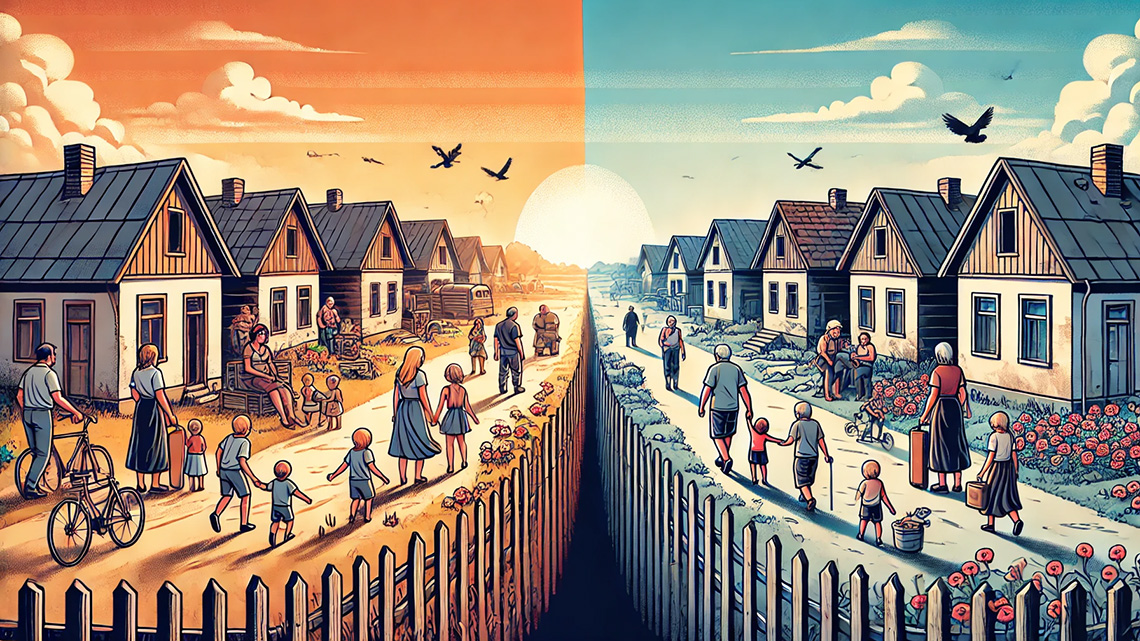
The natural population growth is influenced by two basic components among other factors: birth rate (or natality) and death rate (or mortality). The difference between these two components constitutes the natural population growth in a specific area. The natural development of the population in the Novi Bečej sub-region, observed and analyzed over a longer period, exhibits various changes.
Before the Second World War, all settlements in the present municipality were characterized by a positive natural population growth. Each year, there were more births than deaths across the entire territory of the sub-region. During the Second World War, there was a sudden decrease in population reproduction, a normal consequence of wartime conditions. After the war, the natural population growth increased again, but starting from 1971, the municipality showed a negative natural population growth or hovered on the border between positive and negative growth in each census decade.
In the observed period, the birth rate was very high in 1961 (17.5%), while the death rate was relatively low (9.2%). This resulted in a natural growth rate of 8.3%. Over the next 10 years (from 1961 to 1971), the birth rate dropped to 10.7%, and the death rate increased to 12.6%. These changes in birth and death rates had to reflect on the natural population growth, resulting in a negative growth rate of 1.9%. The negative natural population growth placed the Novi Bečej sub-region in the depopulation areas of the Autonomous Province of Vojvodina.
The negative natural population growth persisted in 1975 and 1976, showing slightly more positive trends in 1977 and 1978, followed by renewed negative tendencies. Comparing the overall natural population growth of Vojvodina and the Novi Bečej municipality in four time periods, it is noticeable that the natural population growth of our province was positive in all the mentioned periods. The Novi Bečej municipality had a positive trend in natural population growth only in the first period, from 1948 to 1953, while in all other periods, it exhibited negative tendencies. In the decade from 1971 to 1980, a consistently negative natural population growth of the municipality was evident, with minor changes at the end of the 1978 and 1980 decades that did not significantly affect the overall negative natural population growth.
Several factors have influenced the unsatisfactory natural development of the population in the Novi Bečej sub-region, with significant emigration of younger population to larger economic centers being among the most impactful. This has significantly reduced the contingent of women in the fertile age group. The long-term lower natural population growth has also resulted in major changes in the age structure of the population. The age pyramid shows a decreasing representation of the youngest and young population, while the category of old and elderly population is increasing. This unfavorable age structure also negatively affects further natural population development.
Significant positive changes in natural population growth can be achieved primarily through social measures. It is essential to make greater efforts to strengthen economic activities in the Novi Bečej sub-region, which would halt or at least mitigate the ongoing process of emigration of the young population from the municipality to economically developed areas of Vojvodina. Municipalities facing depopulation need to be prepared for various forms of material incentives for childbearing in their territories. More attention must be given to childcare while mothers are in the workforce. Unemployed young population should be provided with employment and accommodation. All these measures should contribute to positive changes in the natural development of the population and the demographic characteristics of the Novi Bečej sub-region.

Comments