



Not far from the small town of Novi Bečej in Banat, exactly between Taraš and Kumana, on the left bank of the Tisa River, lies an elliptical-shaped loess plateau, known for centuries by names such as Borđoš, Burduš, or Bordioš, and frequently mentioned as Borjaška Pusta, which belonged to the estate of Lazar Dunđerski.
In the former Hungarian settlement of Burdaš, then deserted and abandoned, Dr. Jene Sentklara, a Hungarian archaeologist and priest in Novi Bečej, discovered in 1875 a prehistoric earthen mound dating back several thousand years.
The first archaeological excavations were conducted between 1894 and 1895 under the leadership of archaeologists Endre Oros and Ištvan Berkes from the Timișoara Museum. Preliminary results revealed the size of the settlement from the late Neolithic period (Neolithic), the thickness of the cultural layer (2 m), and artifacts from daily life. Excavations continued in 1903 and 1904. In addition to the Neolithic settlement, a few hundred meters away, the existence of a Bronze Age settlement was established. During the cutting of the Tisa River in 1895 near Borđoš, a small part of the prehistoric mound was dug. At that time, a cache with 38 bronze artifacts, known as the Borđoš Cache, was discovered. Later, two more caches were found.
Until 1918, the findings from Borđoš were housed in the two largest regional museums in Timișoara and Szeged, and later, the artifacts from the site ended up in the National Museum in Belgrade, the Museum of Vojvodina in Novi Sad, and the National Museum in Zrenjanin.
In the past twenty years, the promotion of the Borđoš archaeological site owes special gratitude to the amateur archaeologist, engineer Joca Bakalov from Zrenjanin. His exceptional finds, such as a scale, have achieved international scientific acclaim, and others, like the plow and harpoon, are also significant.
After a long hiatus, archaeologists from the Museum of Vojvodina and researchers from the Institute of Prehistory and Protohistory at the University of Kiel (Germany) showed interest in modern, multidisciplinary scientific research at Borđoš.
In March 2014, a small geomagnetic survey was conducted on the Borđoš plateau, along with systematic surface collection and geomorphological drilling to determine the thickness and age of the cultural layers using radiocarbon dating. The results revealed the existence of a large Neolithic settlement with houses, protected by a wide circular defensive ditch.
Finally, 120 years after the last excavation at Borđoš, in September 2014, a German-Serbian international team of archaeologists began excavating the late Neolithic site.
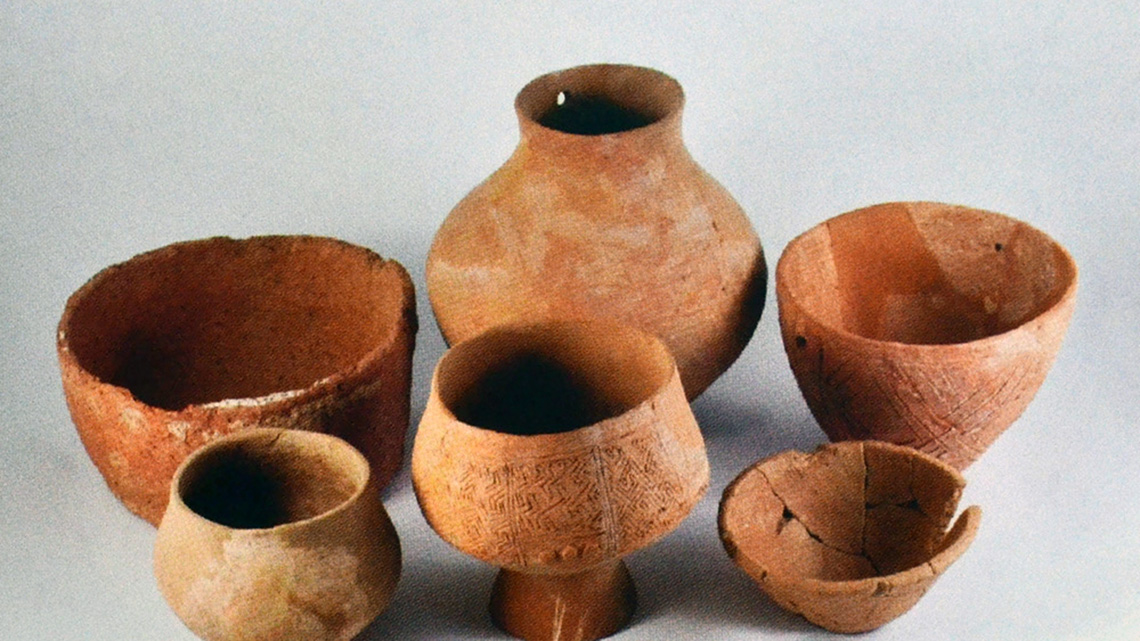
7,000 years ago, people at Borđoš lived a sedentary lifestyle. Their houses were made of earth and wood. They practiced agriculture. On their fields, single-grain and double-grain wheat, barley, flax, peas, and lentils could be found. They raised livestock, mainly cattle, goats, and sheep, and had dogs. Hunting continued to be an important source of livelihood, as evidenced by the discovered hunting tools and animal bone remains. In addition to fish, they also ate shellfish. Food was stored in the house, in large pithoi and pots. They used coarse, hand-made vessels that could withstand fire for cooking. Examples of their luxury ceramics are highly decorative and recognizable in the prehistory of the entire region and are attributed to the carriers of the Potisje cultural group.
Vessels and footed cups, richly decorated with geometric motifs (textile imitation), are representative examples of Potisje ceramics. Besides vessels, their skill and knowledge of the human figure are also evident in anthropomorphic figurines (small seated figurine). The seated statuette with a vessel is one of the unique works of a brilliant prehistoric craftsman. Trade and exchange of goods were well-developed economic activities at that time. This is indicated by various objects found at the site, originating from the Mediterranean (spondylus bracelets), the north (obsidian, radiolarite), and the east (Balkan flint).
In prehistory, Borđoš experienced another peak - during the late Bronze Age (1400 BC). Rich accidental finds, such as the scale, plow, and three caches, confirm the quality of life of its inhabitants. Major climatic changes at that time forced people to bury their treasures and migrate in search of safety.
For a long time, Borđoš was quiet. It was not until the Middle Ages that new settlers arrived.
The exciting archaeological research at Borđoš is accompanied by another story in which the local authorities in Novi Bečej play a significant role. From the very beginning of the research in 2014, the international archaeological team received enthusiastic support and assistance from the Municipality of Novi Bečej. This cooperation goes beyond the bounds of a "best practice example." We do not view the representatives of the local authorities in Novi Bečej as mere collaborators but as part of the archaeological team. To reciprocate to the citizens of Novi Bečej, the international research team at Borđoš organized a multimedia exhibition on the Borđoš site in December 2015, in cooperation with the Local Community and the Cultural Center of Novi Bečej, showcasing original items found during previous two excavation campaigns, as well as copies of items from Borđoš discovered in earlier years. The grand opening of the exhibition was accompanied by prehistoric catering - delicacies from 7,000 years ago. In August 2016, research at Borđoš continued. Again, the archaeological team received logistical support from the small town in central Banat.
Comments