



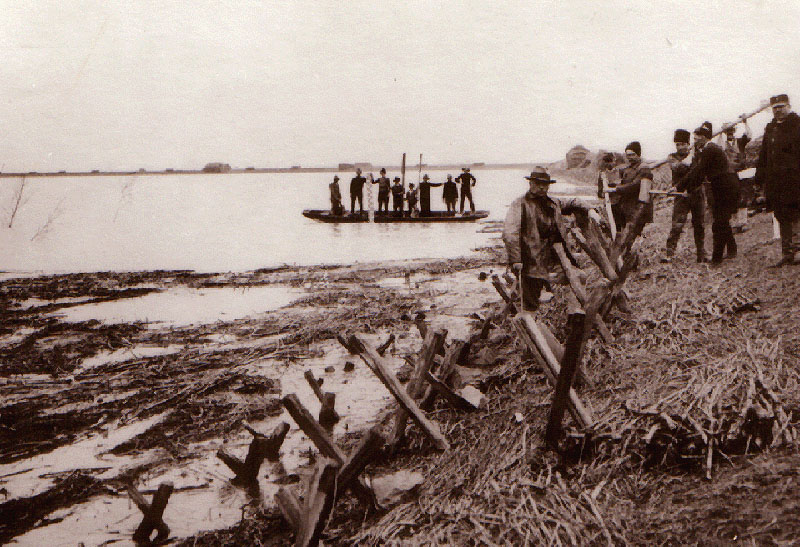
 Thanks to the exceptionally fertile Banat soil, the region was rich in abundant and high-quality grain. The credit for the fact that almost all of this grain flowed into our area goes to the Tisa River. Probably the quantity and quality of the grain, as well as the fact that the (New) Bečej lies on the very banks of the Tisa, provided favorable conditions for the establishment of the largest grain market in the Monarchy. From the early 18th century until the mid-19th century, our port was the most prominent for grain distribution. In order to promote river transport in the Monarchy, Joseph II issued a decree in 1786, stipulating that pulling boats is the heaviest punishment for forced labor on public works.
Our port was crowded with boats, and around them, sweating laborers-loaders performed their job. During that time, crews and merchants found solace in numerous cafes and inns. Work was done, meals were eaten, drinks were consumed, and there was revelry.
However, this prosperity could not last forever. In the early 19th century, the importance of the port declined, and with the construction of the railway line Vel. Kikinda-Turski Bečej-Vel. Bečkerek in 1883, the place would definitively face stagnation.
As much as the Tisa brought prosperity, it also threatened our town. Due to weak embankments, spring floods often threatened the population, leading to the establishment of the Upper Banat "Tisa Cooperative" in 1845, led by Torontal County Deputy László Karačonji. From 1858, the name changed to "VI Section, Third Construction Cooperative," and later became the "Turko-Becskerek Society for Flood Defense." Its activity until 1901 was exclusively flood defense. After that, it took over the responsibility for internal waters and drainage of the drainage basin.


Comments