



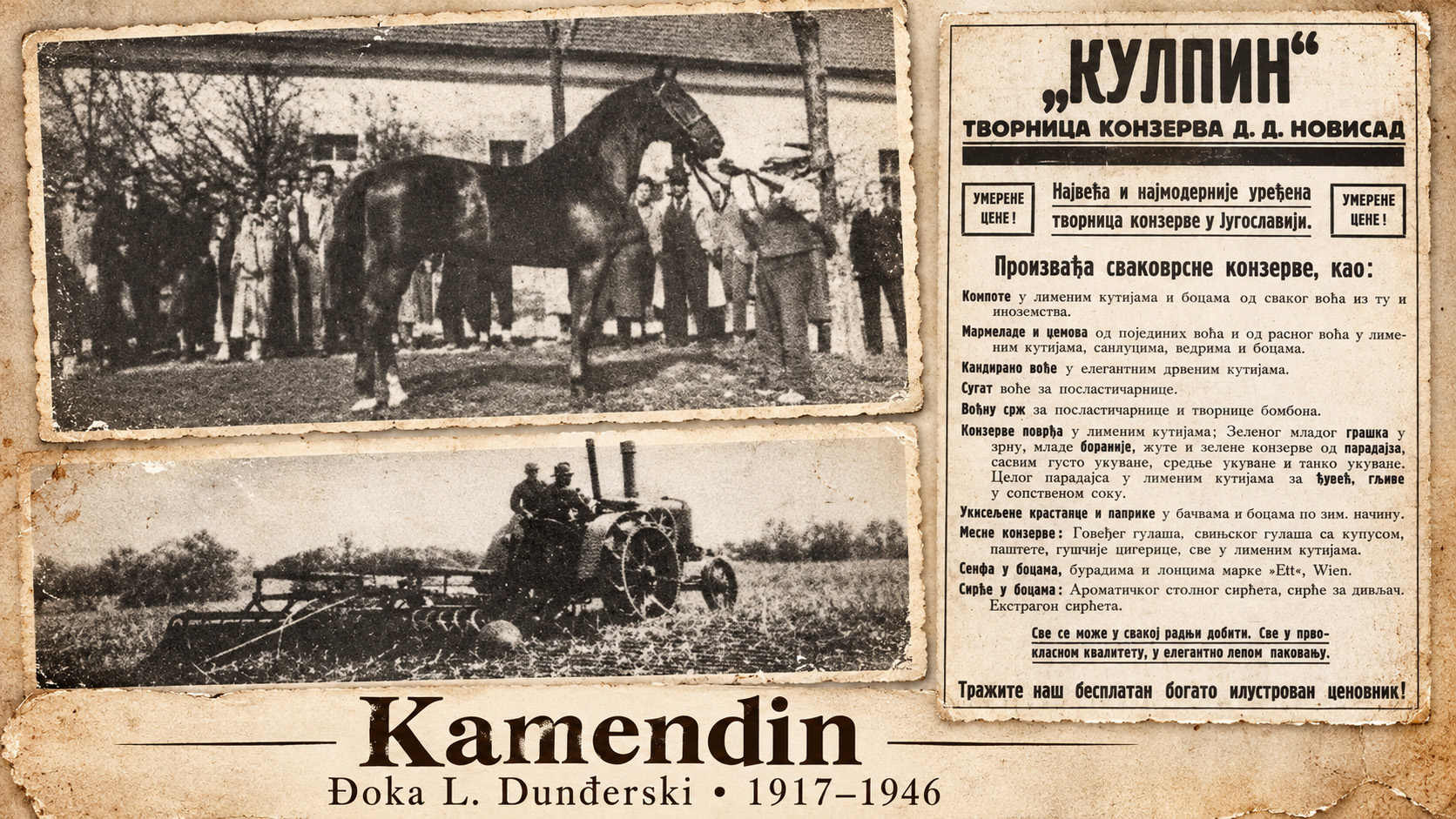
Following the death of Laza Dunđerski, one of the wealthiest Serbs in the territory of present-day Vojvodina, his entire property was divided among his heirs according to his will. As the elder son, Đoka inherited the Kulpin and Kamendin estates, a property in Dobrinja in Bosnia, and smaller holdings in the agricultural districts of Srbobran and Turija — approximately four thousand cadastral jutra in total.
Most likely, Lazar, who had been raised according to patriarchal values and had acquired his property through considerable hardship, work, and dedication, also intended in this way to “punish” his elder son Đoka. By that time, Đoka, a confirmed bachelor, was behaving rather extravagantly and spending his father’s wealth freely.
Following Lazar Dunđerski’s death, during the probate proceedings, Đoka Dunđerski and Dr Gedeon Dunđerski reached the following agreement with their sisters on October 9, 1917:
“Should Mr Đoka Dunđerski die without offspring, he shall be succeeded by the children of Dr Gedeon Dunđerski, namely Lazar and Dušan, as well as any others who may subsequently be born. To safeguard this prospective inheritance, Mr Đoka Dunđerski may not, during his lifetime, dispose of or encumber his immovable property without the approval of Dr Gedeon Dunđerski and the two sisters, Mrs Olga and Mrs Emilija.”
Kamendin and agrarian reform
Like other large estates in Vojvodina, Kamendin emerged from the First World War looted and severely neglected, having suffered the consequences of the “revolutionary” mood among soldiers returning from the Eastern Front. The landless rural poor living on the estate attempted to use the chaotic situation as an opportunity to acquire the much-desired land, which yielded abundant crops.
Like many Serbs in Bačka at the time, Đoka Dunđerski welcomed the creation of the first Yugoslav state with euphoric national enthusiasm. However, he soon faced the fact that his inherited property would also be affected by the agrarian reform prepared and implemented under Regent Aleksandar Karađorđević. The reform was intended to ease the considerable pressure exerted by the impoverished rural population. Having participated in the war, many believed that their particular national contribution to the creation of the new South Slav state entitled them to land.
Almost all the Dunđerski estates were affected by the reform, not only Đoka’s. Under the legal provisions, owners whose holdings exceeded the prescribed maximum, which ranged from 520 to 868 cadastral jutra, were required to surrender the surplus to the state, or rather to the agrarian reform fund.
His brother Gedeon owned more than seven thousand cadastral jutra, with his most important estate at Čib. Stevan, a cousin, owned approximately 3,000 jutra in Srbobran, while Šandor’s son Bogdan owned 1,274 cadastral jutra in the agricultural districts of Srbobran and Stari Bečej.
At that time, and somewhat later, Đoka leased land to the rural poor. In 1928, for example, he leased 458 jutra to impoverished residents of Turija, earning an income of 18,930 dinars.
Compared with his relatives, Đoka proved more enterprising and resourceful in the new circumstances. The agrarian reform legislation allowed landowners who required land for the development of agriculture, particularly livestock breeding and agricultural industry, to retain five hundred jutra. Đoka knew how to take advantage of this provision and succeeded in preserving almost his entire Kamendin estate.
At the time, he owned a total of 1,950 cadastral jutra and 1,530 square fathoms of land at Kamendin. Nearly 1,800 cadastral jutra were arable land, 134 were marshland, eight were pasture, and almost two were woodland.
As early as March 1920, Đoka concluded an agreement with the Ministry of Agriculture and Water, numbered 7360/920. He undertook to maintain two stud farms and an institute producing serum against livestock infections, on condition that he be allowed to retain the land necessary for these activities.
Landless residents of the newly settled villages of Sirig and Pašićevo, now Zmajevo, as well as nearby Temerin, were particularly interested in Đoka’s land. Despite considerable pressure to divide and seize Kamendin’s fertile black soil, Đoka succeeded in keeping almost the entire estate in the Dunđerski family’s ownership and beyond the reach of agrarian reform and colonization.
Arguing that Kamendin and Kulpin were model agricultural enterprises that would benefit agriculture throughout the newly established state and provide raw materials for future serum and vegetable-canning factories in Novi Sad, Đoka Dunđerski submitted a request to the Ministry for Agrarian Reform in late 1920. He asked for a commission to visit Kamendin and establish that all the land he had inherited from his father was indeed necessary both for his activities and for the state.
At the end of December that year, a commission with a distinguished membership inspected the estate. It consisted of Ignjat Marković, head of the County Agrarian Office in Novi Sad; Konstantin Nikolić, secretary of the Ministry for Agrarian Reform; and Đorđe Mitrović, a senior official of the Ministry of Agriculture.
Following their visit, they stated in their report that the estate should not be subjected to agrarian reform:
“Because the owner will use it to develop livestock breeding, produce serum and raw materials for the canning factory, while the stud farm that Đoka Dunđerski is establishing at Kamendin will be of particular importance.”
Almost one thousand jutra were taken from Đoka’s overall holdings through agrarian reform. Of these, 269 cadastral jutra were allocated to war volunteers, while more than six hundred jutra were given to other eligible agrarian beneficiaries.
Through his enterprise and diligence, Đoka succeeded, even during the final settlement of agrarian reform in the early 1930s, in obtaining the largest “supermaximum” land allowance in Bačka.
By a decision of the Ministry of Agriculture dated July 19, 1932, he was permitted to retain a supermaximum of 3,316 cadastral jutra. The reasoning was similar to that given in December 1920:
“Mr Dunđerski possesses a first-class stud farm and modern factories that are of particular benefit to society as a whole.”
The Kamendin Serum Institute
In the early 1920s, Đoka Dunđerski began building factories that relied primarily on raw materials from the Kamendin and Kulpin estates.
The most important industrial establishment in which he invested his money, and through which he managed to retain more than five hundred jutra of land, was the Kamendin Serum Institute joint-stock company in Novi Sad, at what was then 111 Piroški Road.
The institute was founded in 1922 with a capital of three million dinars. Described as the most modern and largest serological institute in this part of Europe and the Balkans, it “produced preparations for the prevention, treatment, and identification of infectious diseases in all species of domestic animals.”
The livestock used in serum production were mostly raised on the Kamendin estate and driven on foot from there to Novi Sad.
The pages of Poljoprivredni glasnik (Agricultural Herald) frequently featured not only advertisements but also reports from Kamendin. Founded in 1921 and published in Novi Sad during the interwar period, the journal contributed considerably to the development of agriculture in Vojvodina through its articles.
The front page of its February 15, 1924 issue was devoted to combating infectious diseases. Among other things, it recorded the following:
“Horses, pigs, and sheep are used as serum animals. There are 24 serum horses. Horses provide polyvalent sera against anthrax, swine erysipelas, swine septicemia, fowl cholera, paratyphoid, strangles, tetanus, and blackleg. Despite large weekly injections of virulent cultures and the weekly withdrawal of four litres of blood from each horse, all the animals are in good condition.
The institute has hygienically arranged pens for one thousand pigs. At present, 156 pigs are being used to produce serum against swine fever, a serum of the greatest importance to our pig farming. These pigs are periodically injected with large quantities of blood from sick pigs, up to half a litre at a time, and after a certain period their blood is collected.
The efficacy of the various sera is tested before they are placed on the market, using small animals such as guinea pigs, rabbits, white mice, and others, while serum against swine fever is tested exclusively on younger pigs…”
The Serum Institute produced protective vaccines against anthrax using the methods of Pasteur and Sobernheim, against swine erysipelas using the methods of Pasteur and Lorenz, and against blackleg. It also produced preparations for simultaneous vaccination against swine fever, as well as preparations against livestock septicemia, canine distemper, swine paratyphoid, fowl cholera, pyosepticemia in suckling animals, strangles, contagious abortion, foot-and-mouth disease, sheep pox, swine pox, and other diseases.
In November 1926, an advertisement in Poljoprivredni glasnik announced that the Kamendin joint-stock company also produced “Mištofinom” and “Sokial žito,” described as effective preparations for exterminating field and house mice. It also announced the beginning of production of a new preparation, “Kaporit,” intended for disinfecting stables, railway wagons, and equipment.
As the most modern establishment of its kind in the country and beyond, the Kamendin institute was frequently visited by students and professors from Yugoslav agricultural faculties, who conducted part of their practical instruction there.
For example, on January 19, 1924, thirty-five students from the Faculty of Agriculture in Belgrade visited the institute under the guidance of Dean Dr Ivan Đaja and Professors Dr Milan Vlajinac and Dr Dobra Todorović. Its director, Dimitrije Konjev, gave them an “informative and interesting professional lecture.”
The Kulpin canning factory
In 1922, Đoka Dunđerski also founded the Prunus joint-stock canning company in Novi Sad, which changed its name to Kulpin in 1924.
By the early 1930s, Kulpin had five million dinars in share capital and employed two hundred workers, ten to fifteen clerical staff, two travelling salesmen, and twelve representatives.
The factory’s annual production, expressed in quantities of raw goods, amounted to approximately 1.5 million kilograms of tomatoes, 180,000 kilograms of peas, 60,000 kilograms of green beans, the same quantity of cucumbers and peppers, 200,000 kilograms of apples and other fruit, and 250,000 kilograms of meat.
A particularly important and commercially successful product was Kulpin’s candied apples, sold as a special delicacy in Belgrade, Novi Sad, Budapest, Szeged, and other places.
Before the Second World War, it was one of the most modern vegetable-processing factories, producing more than four hundred wagonloads annually, compared with just seven wagonloads in its first year.
Đoka was not particularly involved in politics at the time. Nevertheless, Antonije Vildović, the grand prefect of the Bačka Region, appointed him to the Novi Sad city committee, alongside another 66 prominent Serbs, four Hungarians, four Germans, four Jews, and two Slovaks.
Đoka produced most of the raw materials on his Kulpin and Kamendin estates, providing the seasonal workers he employed with relatively decent earnings by the standards of the time.
The railway and the development of agricultural production
Situated only about twenty kilometres from Novi Sad, Kamendin was well placed to supply a substantial market.
Investment in a narrow-gauge railway from the estate to Stepanovićevo became particularly important in the mid-1920s. From there, agricultural and other products could be transported more cheaply and quickly.
The Bačka Sugar Factory in Vrbas was also interested in financing the railway and invested considerable funds in its construction. In return, Đoka Dunđerski was expected to sow approximately five hundred jutra of high-quality sugar beet at Kamendin, both at that time and in subsequent years, thereby repaying the capital invested by the factory.
Until the early 1920s, Đoka had grown only wheat and maize. However, he soon recognized the potential of the Kamendin and Kulpin estates for cultivating other crops. He then began investing more intensively, taking out loans from domestic and foreign banks, particularly those in Vienna and Budapest.
Drawing on his earlier connections, especially those established before the First World War, Đoka Dunđerski succeeded in creating one of the most exemplary agricultural enterprises in the first Yugoslav state. By applying the results of agricultural research from countries more advanced than the Kingdom of Serbs, Croats and Slovenes, later Yugoslavia, he raised production to an impressive level for the time.
The intensification of livestock breeding and the establishment of a Thoroughbred stud farm were important developments at Kamendin. Đoka also sought, often successfully, to cultivate different varieties of wheat, barley, and other crops, alongside raising the most valuable livestock breeds.
He managed to secure duty-free imports and other concessions. On January 9, 1931, for example, he purchased six Simmental heifers for Kamendin in the village of Simontornya, near Székesfehérvár, and imported them without paying customs duties.
Dunđerski frequently purchased and imported various seeds from the Association of Hungarian Farmers, based in Budapest. In November, for example, he bought 19,887 kilograms of Express-variety seed peas from the association, duty-free.
In his application for exemption from customs duties, submitted to the Agricultural Department of the Royal Banovina Administration of the Danube Banovina, he stated that he would “use the seed for sowing on his Kamendin estate and that it would serve to promote the spread of this high-quality variety.”
Đoka Dunđerski did not have a plant-breeding station on his estates. Instead, he obtained the best varieties by importing them from the most reputable foreign stations, particularly Hungarian ones, but also those in Austria, Czechoslovakia, Germany, and other countries.
These institutions placed considerable trust in Dunđerski, whose family name had long enjoyed a good reputation among business partners. Đoka multiplied these seeds on his estates and sold the surplus to other producers.
Seed production at Kamendin
In early July 1931, Đoka Dunđerski offered the Agricultural Department of the Royal Banovina Administration of the Danube Banovina a detailed list of seeds that he was prepared to sell.
This surviving document reveals the varieties cultivated at Kamendin and provides information about yields. These were considerable for the time and were not matched for many years after the Second World War.
Đoka wrote:
“I have the honour of offering seven different varieties of improved wheat seed, winter barley, and Pannonian vetch. I have cultivated these seeds for many years, and they have been thoroughly tested. Their principal characteristics are as follows:
- Sirbano frolifik — strong straw, high yield, closed flowers rather than open ones as in other frolifik varieties, making it less susceptible to bunt. Medium growing period. I have 2,350 metric quintals of this wheat variety for sale.
- Sekač 266 — straw of medium strength. Medium growing period, good yield, good quality, and a high protein content. I have approximately two thousand metric quintals of this wheat variety for sale.
- Sekač 1055 — weaker but very flexible straw; does not require rich soil and therefore grows well on poorer land. Suitable for later sowing, very good quality, smaller grain, and early ripening. I have approximately nine hundred metric quintals of this wheat variety for sale.
- Leganj 3490 — strong straw, high yield, good quality, and somewhat later ripening. I have approximately 1,300 metric quintals of this variety for sale.
- Leganj 1153 — strong straw, high yield, good quality, and somewhat later ripening. I have approximately 250 metric quintals for sale.
- Leganj 1119 — very strong straw, high yield, requires rich soil, and has a high protein content. Longer growing period. I have approximately four hundred metric quintals of this variety for sale.
- Flajšman 481 — straw of medium strength, good tillering, high yield, hardy, and does not require rich soil; suitable for saline soils. This year, I expect an average yield of 30 metric quintals per hectare. I intend to grow this wheat variety predominantly on my farm because of the characteristics of my soil. I have approximately 3,800 metric quintals of this variety for sale.”
This document reveals not only the wheat varieties Dunđerski grew at Kamendin and the yields he expected, but also that he analysed the soil and selected varieties accordingly. This was rare in Bačka at the time and reflected a modern commercial approach to farming in the region.
The document continued:
“Peragis winter barley was produced by crossing Rebeka and Gizika. I have grown it for several years, with an average yield of 30 to 35 metric quintals per hectare. It ripens very early, between June 8 and 10, and can also be used as malting barley. The straw is fairly strong. I have approximately 1,500 metric quintals of this variety for sale.
Pannonian vetch — wild vetch improved as a winter crop. Very good as livestock fodder. Its advantage over spring vetch is that it makes very good use of winter moisture and consistently produces high yields of 65 to 75 metric quintals per hectare. Since it is cut as early as the beginning of May, early maize, foxtail millet, buckwheat, and other crops can be successfully sown afterwards as follow-on crops.
As for wheat, I offer it at the market price prevailing at the time of sale, with an additional charge for the exceptional costs of improving and selecting the seed, equivalent to that charged on the state-owned Belje estates. I offer winter barley at 180 dinars per metric quintal and vetch at 650 dinars per metric quintal.”
Đoka specifically noted that the quoted prices applied to goods loaded into a railway wagon at Pašićevo station, without sacks.
He concluded his letter with the following words:
“Since there is very considerable interest in my seed, particularly this year, I have the honour of asking the Administration to inform me, as soon as possible, which of the above-mentioned seed varieties it wishes to purchase and in what quantities.”
At Kamendin, Đoka primarily grew sugar beet, and this was no coincidence. The crop had a guaranteed market at the Sugar Factory in Vrbas, while its transport made the railway increasingly profitable.
He also sowed a large proportion of the arable land with hemp, which supplied his factory in Kulpin. Wheat occupied approximately 300 jutra, while maize was grown on half that area, with an annual yield of about 30 metric quintals per jutro. A smaller area was planted with vegetables, as these were mainly grown on the Kulpin estate.
Alongside applying scientific advances in agriculture and livestock breeding, Đoka used the most modern agricultural machinery available at the time. His equipment included tractors, threshing machines, seed drills, various attachments, and other implements.
Fairs, awards, and professional visits
Đoka Dunđerski was also highly active in organizing agricultural fairs and exhibitions in Novi Sad. He was one of those most responsible for their rapid development into established international events.
His livestock from Kamendin appeared at all these exhibitions, held annually from 1931.
At the Eighth Livestock Exhibition and Fair, Đoka had his own pavilion, which was also the largest. It displayed valuable horses, pregnant sows, agricultural produce, and products from his two largest factories.
He received first prizes for twelve-month-old Mangalica sows and Berkshire sows up to eleven months old. The following year, 1939, Dunđerski again received first prize for his entire exhibited group of Mangalica pigs, together with a trophy presented by Minister of Trade Jevrem Tomić. Đoka’s horses, raised at Kamendin and Kulpin, also achieved notable successes and won awards.
As a model agricultural enterprise, Kamendin frequently received visitors wishing to learn about the most advanced agricultural practices of the time, particularly in livestock breeding.
On June 19, 1930, the Farmers’ Association of Temerin organized a visit to Kamendin for its members. A reporter for Temerini Újság recorded that the visitors:
“Who admired the very fine pens and breeds of pigs and other livestock, but regretted that an outbreak of disease prevented them from seeing the pedigree racehorses, were received by the manager, Jožef Keri. He spoke to them about modern methods of production, showed them various wheat varieties, and also demonstrated the enormous damage caused to the sugar beet by black caterpillars…”
Like the Serum Institute, Kamendin was frequently visited by students from agricultural faculties.
In April 1936, while attending the Sixth International Exhibition and Fair of Breeding Livestock, students from the Faculty of Agriculture in Zagreb, led by Professor Dr Guči, also had an opportunity to visit Kamendin.
An agronomy student who took part in the excursion recorded the following in Poljoprivredni glasnik:
“Through the kindness of Mr Đoka Dunđerski, the students were given the opportunity to visit his model agricultural enterprise. On this large farm — of which there are few in our country — the achievements of agricultural science are rationally applied to obtain the greatest possible profitability in agricultural production.
Several wheat varieties, including Sekač, Bankut, Leganj, and others, have been sown over large areas of excellently cultivated fields, so that comparative trials may establish which variety is best suited to profitable production in this region.
Field crops are grown here both for direct sale on the market and for processing in the owner’s factories. Hemp from this estate, for example, has met the highest quality requirements of foreign markets and is therefore much sought after. […] Wheat yields reach up to 20 metric quintals per jutro.
One field presented a splendid example, with more than one hundred oxen, mostly of the Podolian breed, pulling ploughs and harrows.
Horse breeding and pig farming are particularly prominent in livestock production. The English Thoroughbred stud farm possesses excellent breeding stock, whose considerable value is demonstrated by numerous victories on domestic and foreign racecourses.
The transition to breeding Gidran horses is dictated by the need for a good, hardy horse that can be used for agricultural work, carriage driving, and riding for national defence purposes. Such a strong-boned, enduring horse with combined practical uses is much sought after in Vojvodina.
Two pig breeds are represented: Berkshire and Yorkshire. Berkshire pigs are mainly intended for export and fattening, while Yorkshires are used for serum production, being the most suitable for that purpose.
Spacious, hygienically arranged pigsties, with numerous pens for breeding sows and practically designed, partly covered facilities for fattening pigs, demonstrate the considerable attention devoted to pig farming on this estate.
Since there are no suitable conditions for selling milk, cattle production is not intensive. Most of the milk is distributed to the estate’s workers, while the remainder is used as liquid feed for the Yorkshire pigs.
A large silo tower makes it possible to feed properly more than two hundred oxen, which provide draught power for cultivating the fields and produce farmyard manure.
The students followed all the explanations and information given during the tour with considerable attention and interest.
On the return journey from Kamendin, a visit was also made to Mr Forgač’s farm near Novi Sad…”
The lives and work of agricultural labourers
Agricultural labourers at Kamendin lived under relatively difficult conditions, although these were considerably better than those on other estates. During the sugar beet harvest, seasonal workers were often recruited from as far away as Slovenia, with the Vrbas sugar factory arranging their employment.
The working day began at four in the morning and continued until late at night, with a half-hour breakfast break and an hour and a half for lunch. At the height of the season, work continued on Sundays. Only state and religious holidays were exempt from work.
During the 1930s, seasonal workers received a daily wage of twelve dinars.
Permanent employees on the estate were in a considerably better position. In addition to monthly wages of up to four hundred dinars, they received payment in kind: eighteen to twenty “metars” of grain, six “metars” of shelled maize, the right to cultivate one jutro of land per household member, and four “squares” of garden land.
Those who worked with livestock were also entitled to two litres of milk a day.
On the eve of the war, approximately thirty-five workers’ families lived at Kamendin. Most were Hungarian, with some Slovaks, Serbs, and others. Families generally consisted of six to nine members.
They lived in housing with limited sanitary amenities. Four families shared a kitchen, while each family had only one room, without electric lighting. Even this accommodation was considered “more comfortable” than that on other nearby farmsteads.
Despite such difficult living conditions, no workers’ strike was recorded at Kamendin during the interwar period. A smaller strike occurred at nearby Kulpin in May 1936, when workers hoeing sugar beet demanded an increase of three to five dinars in their daily wages.
According to older workers who had been employed at Kamendin at the time, strikes did not occur because there was no organized labour movement, and because their employer, Đoka, usually accommodated their demands.
Đoka Dunđerski’s assets and debts
In the early 1930s, Đoka Dunđerski’s property was valued as follows.
Livestock and other farm inventory on the Kamendin, Kulpin, Pajin salaš, and Garavica estates were valued at 6,200,000 dinars.
The value of buildings and associated real estate was:
| Property | Estimated value |
|---|---|
| Hotel Sloboda in Novi Sad | 4,000,000 dinars |
| House in Dunavska Street, Novi Sad | 1,200,000 dinars |
| Two houses in Kulpin | 800,000 dinars |
| Hemp factory in Kulpin | 600,000 dinars |
| Half of a house in Budapest | 6,000,000 dinars |
| Total | 12,600,000 dinars |
His land, covering 4,351 cadastral jutra, was valued at approximately 35,000,000 dinars.
Racehorses and trotters insured with “Rosija fonsijer” were valued at 32,018,600 dinars.
The securities listed included:
| Securities | Stated value |
|---|---|
| 5,800 shares in Kamendin | Nominal value of 2,900,000 dinars |
| 285 shares in the Serbian Bank in Zagreb | 21,375 dinars |
| 17,845 shares in Prunus | 4,461,250 dinars |
Other securities were also listed, bringing the stated total assets to 63,479,720 dinars.
The liabilities included the following debts:
| Debt | Amount |
|---|---|
| Serbian Bank in Zagreb, Novi Sad branch | 3,900,000 dinars |
| Unpaid interest owed to the same bank for 1932 | 1,653,000 dinars |
| Serbian Bank in Zagreb, bills of exchange backed by an additional guarantee | 15,000,000 dinars |
| National Bank, Novi Sad branch | 11,000,000 dinars |
Including other debts, total liabilities amounted to 44,917,683 dinars, leaving a net worth of 18,562,037 dinars.
The establishment and development of the stud farm
At Kamendin, Dunđerski also owned a widely renowned English Thoroughbred stud farm. It had been established in 1890, during Laza Dunđerski’s lifetime, following the example of many well-known stud farms in Hungary.
At that time, the stud farm had approximately thirty breeding mares and stallions of English half-bred stock, purchased by Laza throughout Hungary, including from the famous military stud at Mezőhegyes.
A report by Bačka County, written shortly after the stud farm’s establishment, stated that it had developed so successfully that it already ranked among the best-known establishments of its breeding type. Its principal purpose was to breed military remounts and high-class racehorses.
Even in those early years, military remount commissions regularly purchased fifteen to twenty horses annually from Dunđerski.
At the beginning of the twentieth century, the stud farm expanded rapidly through the purchase of numerous pedigree animals. Among these acquisitions was the entire stud farm of Baron Rudić from Bački Aljmaš, near Subotica.
In 1906, during a period of expansion and the development of valuable breeding stock, a fire broke out in the main stable, where the finest animals were housed. Many horses, particularly breeding mares, could not be saved.
Despite this catastrophe, the stud farm continued operating with the younger breeding stock that had survived. However, the First World War soon broke out, and most of the horses were requisitioned for military use.
After the war, Đoka Dunđerski continued breeding first-class English Thoroughbred and half-bred horses.
In 1917, he purchased the English Thoroughbred stallion Royal Igl at an auction in France. The horse was brought to Kamendin only after the breakthrough on the Salonika Front in 1918.
An interesting episode is associated with this breeding stallion. During transport from France, Royal Igl was loaded onto a ship bound for Salonika together with several mules, from which he contracted epizootic lymphangitis, referred to in the source as “false glanders.”
Arriving at the stud farm with the disease, he was recorded as the first horse in Bačka infected with it. The disease spread through Vojvodina over the following years and decades, continuing even after the Second World War.
From 1919 in particular, Đoka Dunđerski intensified his efforts to develop the English Thoroughbred and half-bred stud farm at Kamendin. His motivation was not only his great love of horses but also the opportunity, under agrarian reform legislation, to retain five hundred jutra of land for establishing a stud farm and keeping Thoroughbreds.
Together with his close friend, the “sportsman and horse breeder” Vlada Ilić, he frequently attended auctions throughout Europe and purchased pedigree horses, including at the celebrated Czech stud farm at Napajedla. If a horse appealed to him, he did not ask the price.
Breeding conditions and the best-known horses
According to Dr Nikola Vuksanović, director of the state stud farm at Karađorđevo, writing in Poljoprivredni glasnik on March 15, 1923, Đoka had all the necessary conditions at Kamendin for breeding English Thoroughbred and half-bred horses.
Among other things, Vuksanović stated:
“The Kamendin estate lies in the heart of the fertile Bačka plain, near Srbobran and only some twenty kilometres from Novi Sad. The soil itself is exceptionally fertile, with abundant calcium phosphate. This is very important in horse breeding, particularly in breeding English Thoroughbreds, because of skeletal development.
When one adds that the water is good and the pastures are spacious and covered with lush, palatable grasses immediately beside the stud stables, the location has been well chosen.
The complex of buildings, including the stud stables, turnout areas, and accommodation for officials, trainers, and other staff, lies at the very centre of the estate. The stables housing the breeding stock and young horses are spacious and bright, practically arranged, and well ventilated.
Adult mares with suckling foals are housed in spacious boxes, as are the stud’s horses undergoing training. All the other horses are kept in communal stables, where they are raised to be hardy while receiving sufficient feed. The owner himself takes particular care that his young stock should not become overly pampered.
The entire building complex is currently being adapted, and new stables are also being constructed, so that in a few years Kamendin will have a different and renewed appearance.”
At that time, the Kamendin stud farm had four stallions. Besides Royal Igl, another well-known stallion was Loren, also of French origin. They served fifty-six Thoroughbred mares belonging to the stud’s own breeding stock.
The principal breeding stallions in the late 1920s were Karmento II, foaled in Hungary in 1918, and Fruškogorac, foaled in Czechoslovakia in 1920. Spiridon II and Simplon were later acquired from Czechoslovakia.
Đoka’s greatest favourite, however, was Idomeneus, immortalized in an oil painting by the artist V. Vesterop.
Đoka Dunđerski also owned an American trotter stud farm on his Kulpin estate. At the beginning of 1929, he had fourteen purebred mares, with the American trotter Rekontra serving as the breeding stallion.
The stud’s best mare was Leanjka, which achieved notable successes throughout Europe. These included second place in a race in Berlin in 1923.
The stud farm’s greatest success came in Vienna in 1921, when Đoka Dunđerski’s horses took all the first places.
Notable results were also achieved in domestic races. It was recorded that, from 1919 until shortly before the Second World War, horses from the Kamendin stud won a total of 462 first prizes. There were also seven winners of Yugoslav derbies. The mares Pajtoš and Kete were particularly distinguished.
The year 1926 was especially successful in Novi Sad. In the Fifth International Race, over a distance of 2,400 metres, Seljanka won the first prize of five thousand dinars. Džungel finished first in the sixth jumping race, held over a distance of 3,200 metres.
Contributions to equestrian sport
As a great enthusiast and breeder of pedigree horses, Đoka served for many years as president of the Vojvodina Riders’ Association “Crown Prince Petar” in Novi Sad. In this capacity, he made a significant contribution to the development of equestrian sport in the city.
He was also instrumental in organizing the first equestrian event in Novi Sad on August 8, 1926.
A reporter for Poljoprivredne novine (Agricultural Newspaper) wrote that the date would be remembered as an important one in the city’s history:
“The first equestrian meeting has demonstrated that Novi Sad has every condition necessary to take the leading position in this noble sport throughout the country, because the greatest number of racehorses and racing stables are owned by people from Vojvodina.”
The reporter then noted:
“The activity and atmosphere at the racecourse differed in no respect from those of other metropolitan racecourses. More than two thousand people sat in tightly packed rows on the magnificent, enormous grandstand. The race was also a parade of luxurious women’s fashions, gentlemen with round spectacles, grey coats, and Oxford trousers, and splendid officers’ uniforms…”
Horses bred at Kamendin also won first prizes and special awards at various fairs. From 1936, the estate began breeding horses of the Gidran breed, used for agricultural work and military purposes.
Dunđerski enjoyed various concessions when purchasing pedigree horses throughout Europe and importing them. He frequently obtained duty-free entry on the grounds that he would use the animals “exclusively for breeding, in order to improve the breed of his stud farm.”
In mid-January 1941, for example, he imported from France two English Thoroughbred mares, aged eight and ten, and three seven-month-old foals. He accepted the obligation to pay ten times the normal customs duty if the horses were used for other purposes.
Debts and the sale of part of Kamendin
Having incurred substantial debts, particularly with the Budapest Bank through which he purchased seeds and livestock, and facing difficulties on the eve of the Second World War, Đoka Dunđerski was forced to sell horses at auction.
In the December 3, 1940 issue of the Novi Sad newspaper Dan (Day), he announced an auction offering forty-three horses from the stud farm. These included thirteen English Thoroughbred mares and stallions, such as Foks grl, Sremica, Rumenka, Ljubimče, and Rodoljub, as well as six American purebred mares and other horses.
Yet, on December 5, the same newspaper informed its readers “that Mr Dunđerski had donated 100,000 dinars to the poor of Novi Sad for winter relief.”
Đoka could not repay his debt on his own. On March 6, 1941, only a month before the outbreak of war, the Belgrade newspaper Politika reported that the Danube Banovina had purchased a large part of the Kamendin estate on February 13, 1941. The reporter stated that the Minister of Finance had personally approved the purchase agreement.
The Banovina intended to establish an even more exemplary farm and stud on the well-known Kamendin estate. Under the agreement, it was to purchase 1,081 jutra of arable land at a price of 25,000 dinars per cadastral jutro. The same agreement included the purchase of the thirteen-kilometre railway to Stepanovićevo, together with a locomotive and eight wagons.
The total price payable by the Danube Banovina was 27,048,484 dinars. Under the agreement, the buyer borrowed this amount from the State Mortgage Bank. The loan was to be repaid over ten years, at an interest rate of seven per cent, with all Banovina revenues serving as security for the annual repayments.
Despite the high price for more than one thousand jutra of Kamendin land, the Danube Banovina had an economic rationale and an interest in the purchase. As early as the beginning of 1940, its Agricultural Department had expressed a desire to establish a larger Banovina-owned agricultural estate near Novi Sad, and this opportunity suited that purpose.
A Banovina commission consisting of engineers Bogdan Jarakula, Dušan Ćirić, and Petar Katić inspected the Kamendin land and recommended its purchase, which took place on March 11, 1941.
According to accounts given by older Kamendin workers, surveying of the land had also begun. Since the Agricultural Department could not use the land during that farming year, it offered the lease at auction.
On March 27, the Novi Sad agricultural entrepreneur Pavle Popović — Pecija offered a rent of 1,800 dinars per jutro, but the war prevented these plans from proceeding.
The surviving purchase agreement, signed by the owner Đoka Dunđerski and the then Ban of the Danube Banovina, Dr Branko Kijurina, specifically stated that Dunđerski:
“May use for his own purposes a five-kilometre section of the railway, the Montania locomotive with a 32-horsepower petrol engine, two large double wagons, and other equipment.”
Kamendin under occupation
Đoka Dunđerski spent the first days of the April War in 1941 with his family in Dubrovnik. Using his earlier Budapest connections and acquaintances, he returned to Novi Sad, which, like the rest of Bačka, had been annexed by Hungary.
The occupying authorities appointed commissioners to all Đoka’s enterprises and to his estate. Their task was to direct the entire property towards supporting the war effort in alliance with Germany.
Dr Mihalj Mikloš Sabo was appointed wartime administrator and commissioner of the Kulpin canning factory, which had been declared a strategic enterprise of particular importance to the state.
At Kamendin, however, Karolj Sabo remained the actual manager, a position he had held since 1933, while Lazar Kolarski supervised livestock production.
Throughout the occupation, Kamendin continued producing supplies for the Kulpin factory, the Vrbas sugar factory, and the Serum Institute.
Hunting and distinguished guests
Like other members of the Dunđerski family, Đoka devoted considerable attention to hunting. He invested substantial sums in leasing hunting grounds.
The January 1925 issue of Lovački glasnik (Hunting Herald) informed its readers:
“On December 23, 1924, Mr Đoka Dunđerski organized a hunting party on his estate for his friends. Before the hunt, the participants toured the model agricultural enterprise and then set out to hunt.
The hunt was directed by our fellow hunter Ivica, a well-known master of hunting techniques, including the positioning of shooting stations, driving game, organizing the beat, and so forth.
The final result was 105 hares killed by 12 guns, a good dinner and even better drink, one torn pair of breeches, the reconciliation of two quarrelling hunters, and the continuation of the hunting festivities with empty guns in Novi Sad.”
According to the same journal, Prince Pavle Karađorđević also visited Đoka’s hunting grounds. It records that he hunted with Đoka Dunđerski on November 9, 1927:
“Also present were the Czechoslovak envoy Šeba, the well-known friend of our people Mr Archibald Reiss, and other distinguished guests.
The hunt lasted from nine in the morning until five in the afternoon. The results were excellent. All those present who had the honour of being in the company of His Highness Prince Pavle were charmed by his extraordinary kindness and gracious approachability, as well as his enthusiasm for hunting, in which the distinguished guest proved an excellent shot.
After the hunt, the host, Mr Dunđerski, provided a dinner on his estate, which passed most pleasantly.”
Historical documents also record that, in 1930, Đoka Dunđerski leased one thousand jutra of hunting grounds, paying the state 30,000 dinars annually.
Charitable work
Between the two world wars, and later as well, historical sources recorded Đoka Dunđerski as a major benefactor. He was particularly active in helping the poor of Novi Sad.
On the front page of its December 8, 1940 issue, the newspaper Novi Sad described Mr Đoka Dunđerski as a great benefactor of the city’s poor. By providing assistance in money and in kind during the most difficult winter days, he had done much to make their circumstances more bearable.
The newspaper’s journalist also wrote:
“At the head of the most generous supporters of the poor of Novi Sad stands our distinguished industrialist and well-known benefactor, Mr Đoka Dunđerski. He is known for his kindness, generosity, and understanding of the hardships of the poor, and has, on countless occasions, sacrificed much for the common social good.
On this occasion, Mr Dunđerski has made a substantial contribution of 100,000 dinars to Novi Sad’s winter relief fund. This is a record amount donated by a single individual for this charitable purpose!
Through this noble and admirable gesture, Mr Đoka Dunđerski has once again demonstrated that he is a true friend and protector of the poor. Taking into account today’s difficult, serious, and unfortunate circumstances, which affect the poor most severely, he has sought not only to increase his own assistance but also to set an example for others of how to help those in the greatest social need.
This humane act by Mr Dunđerski deserves every praise and recognition. Its reward will be the heartfelt and warm blessings of thousands of unfortunate people whose present, exceptionally difficult circumstances have been substantially eased by this impressive financial contribution from their noble benefactor.”
Wartime production and political involvement
Kamendin continued production during the Second World War. Under the influence of the Hungarian authorities, and drawing on his earlier Budapest connections, Đoka Dunđerski directed agricultural production towards the needs of the war being fought by Horthy’s Hungary.
His factories, particularly Kulpin, were of special importance to the Hungarian occupying authorities. Showing a degree of distrust towards this Serb from Vojvodina, they installed compulsory administrators on his estates and in his factories. This took place within the framework of the Military Administration introduced in Bačka during the first months of occupation, which lasted until September 1941.
During this period of upheaval, Đoka Dunđerski managed to regain access to slightly more than one thousand jutra of Kamendin land, but only as a tenant. This was the land he had sold to the Royal Banovina Administration shortly before the war.
During the war years, Dunđerski also became politically involved to a certain extent. In August 1941, on the recommendation of Hungary’s Minister of the Interior, he became a member of the council of Bács-Bodrog County. Other members included his cousin Bogdan, a landowner in the agricultural districts of Srbobran and Stari Bečej, Stevan Ilkić from Novi Sad, Žarko Stejić from Bačko Gradište, and other Serbs from Bačka. At the end of the same year, he also became a member of the Municipal Council of Novi Sad.
The tragic events of the Novi Sad Raid in January 1942 left a deep mark on Hungarian–Serbian relations, extending beyond the war itself.
Using his connections and acquaintances, Đoka managed to leave Novi Sad during those days and find safety in Budapest. He returned only when the situation had calmed somewhat.
Most likely, Milan L. Popović warned him about the impending tragic events in Novi Sad and advised that prominent Serbs should leave the city for a time.
Assistance to prisoners in the Sárvár camp
Đoka Dunđerski continued to be a significant benefactor during the war.
At a time when the Hungarian occupying authorities were attempting to change their attitude towards the Serbian population, he became involved in sending assistance through the Serbian Orthodox Church to Serbian colonists imprisoned in the Sárvár camp.
The camp held families of Serbian colonists who had settled in Bačka after the First World War and had been expelled following the changes of April 1941. The valuable assistance sent in 1942 was intended primarily for children.
Đoka Dunđerski also participated in an Easter relief campaign, during which more than 10,000 eggs, 1,200 kilograms of cakes and pastries, and 1,766 items of men’s and women’s underclothing were sent.
In addition, Dunđerski sent eight wagonloads of straw, several hundred tins of food, four wagonloads of sauerkraut, and two wagonloads of beans, considerably improving the food supply in the camp.
Đoka generously and patriotically continued to help these colonists when they returned to Novi Sad during the war. According to some accounts, his Kulpin canned-food factory fed almost the entire Podbara district of Novi Sad.
His assistance to the Sárvár Hospital in Novi Sad, located in Marija Trandafil Square, was also significant.
The final war years and the change of ownership
In 1943, Dunđerski, as an anti-Bolshevik, attempted to distance himself from Partisan operations, particularly the burning of grain fields intended to prevent production for the Hungarian occupiers.
As Partisan operations became more frequent, the Hungarian authorities demanded that prominent Serbs in Bačka issue another declaration of loyalty to the Hungarian state and condemn communist activity in early October 1943. Đoka Dunđerski was among them.
The chaotic wartime situation, in which the Hungarian occupiers were increasingly losing their hold on power, led to a substantial reduction in production at Kamendin. Nevertheless, Dunđerski continued trying to save his estate, failing to understand that a new and different era was approaching, in which saving his own life was more important.
During the period of “revolutionary changes,” when it was considered necessary to “deal with representatives of the capitalist class and the bourgeoisie,” Đoka Dunđerski unquestionably belonged to the category being targeted. He was regarded as a potential opponent of the new order. Above all, as an anti-Bolshevik and anti-communist, he had to be punished according to the thinking and attitudes of the time.
The estate became state property through the application of the Law on Crimes against the People and the State, whose Article 10 prescribed punishment for collaboration with the occupiers. These matters will be discussed further in the following pages of this book.
However, based on my research, primarily in archival sources, into this exceptionally complex period of Vojvodina’s recent history, I have concluded that the economic strengthening of the new authorities was also important to the establishment of communist political supremacy: property had to be taken from some so that it could be given to others as compensation for so-called “wartime merits.”
I do not intend here to discuss the extent of the mistakes undoubtedly made in these efforts, not only towards the Serbian “bourgeoisie” but also towards members of national minorities — Germans and Hungarians. They, too, paid a heavy price for wartime alliances and national and ideological misconceptions, the consequences of which were borne by entire subsequent generations.
Comments